What effective structural cue does this activity report use to help the reader?
Chapter 11: Business Reports
Venecia Williams
- Understand the different types of reports
- Discuss the main parts of a formal written report
- Examine how to use headings and lists
- Learn how to integrate graphics
Reports are documents designed to record and convey information to the reader. Reports are function of any concern or organization; from credit reports to sales reports, they serve to certificate specific data for specific audiences, goals, or functions. Reports come in all sizes only are typically longer than a page and somewhat shorter than a volume. The blazon of report depends on its role. The part of the written report is its essential purpose, ofttimes indicated in the purpose statement. The function may likewise contribute to parameters like study length (page or discussion count) or word option and readability. Reports vary past role, but they also vary by style and tradition. Within your organization, there may be employer-specific expectations that need to be addressed to come across audience expectations.
Informational or Analytical Study?
There are two master categories for reports, regardless of their specific role or type. An informational written report informs or instructs and presents details of events, activities, individuals, or atmospheric condition without analysis. An example of this type of "just the facts" report is a summary report. The written report will summarize the nearly pertinent information from a text based on the audience'due south needs.
The second type of report is called an analytical report. An analytical report presents information with a comprehensive analysis to solve problems, demonstrate relationships, or brand recommendations. An instance of this study may exist a field report by a physician from the Public Health Agency of Canada from the site of an outbreak of the Covid-xix virus, noting symptoms, affliction progression, steps taken to arrest the spread of the disease, and recommendations on the handling and quarantine of subjects.
Informal and Formal Reports
Reports tin can as well be classified every bit breezy and formal reports. Informal reports tend to be a few pages long and are ordinarily written for someone within the organization. Informal reports are ordinarily sent as memos, sometimes fastened to an email, or as letters. Formal reports, on the other hand, are much longer and are usually, though not always, sent outside an organization. Whether you lot write an breezy or formal report depends on the audience for the report and the information required.
Writing a Formal Written report
Many business professionals need to write a formal written report at some indicate during their career, and some professionals write them on a regular footing. Key conclusion-makers in business concern, education, and government apply formal reports to brand of import decisions. As opposed to informational reports that offering facts and information without analysis, formal reports provide the end production of a thorough investigation with assay. Although writing a formal report can seem like a daunting task, the final product enables you lot to contribute straight to your visitor's success.
While y'all may write much shorter, more than coincidental reports, it's helpful to go into a scrap of detail about formal reports. Formal reports are modular, which means that they take many pieces. Most audience members will not read every slice, and then these pieces should stand on their own. That means that you will oft repeat yourself. That's okay. Your audience should be able to find exactly what they demand in a particular section, even if that data has been repeated elsewhere.
While it'southward fine to copy and paste between sections, you volition likely need to edit your work to ensure that the tone, level of particular and organization meet the needs of that department. For instance, the Executive Summary is aimed at managers. Information technology'southward a short, persuasive overview of everything in the report. The Introduction may contain very similar information, but information technology focuses on giving a brusk overview of everything in the study. Its goal is to inform, not to persuade.
Study System
Reports vary by size, format, and role. You need to exist flexible and suit your study to the needs of the audience. Reports are typically organized around vi key elements:
- Who the report is nigh and/or prepared for
- What was done, what bug were addressed, and the results, including conclusions and/or recommendations
- Where the field of study studied occurred
- When the subject studied occurred
- Why the report was written (function), including under what authority, for what reason, or by whose request
- How the discipline operated, functioned, or was used
Pay attention to these essential elements when you consider your stakeholders. That may include the person(southward) the report is nearly, whom information technology is for, and the larger audience of the organization. Ask yourself who the key decision-makers are, who the experts will be, and how your words and images may be interpreted.
While at that place is no universal format for a report, there is a common order to the data. Each element supports the main purpose or role, playing an important role in the manual of information. There are several unlike organizational patterns that may be used for formal reports, but all formal reports comprise front end matter (prefatory) fabric, a body, and back matter (supplementary) items. The prefatory fabric is therefore critical to providing the audition with an overview and roadmap of the report. The torso of a formal report discusses the findings that atomic number 82 to the recommendations. The back thing provides additional information. Some common elements in a report are shown in Figure 11.one.
| Page | Description |
Championship folio | Written report title; appointment of submission; proper noun, championship, and organization of the person who prepared the written report; name, title, and arrangement of the person receiving the written report. If your report contains sensitive information or if it is going to be exposed to the elements, it might too contain a cover page. No page number. |
Table of contents | A list of the sections in the report and their respective page numbers. All headings/sub-headings in the written report should be listed on this page. This folio is not labelled with a folio number. |
Executive summary | The executive summary is a one-page overview of the entire study aimed at managers or people in a position of power. It discusses the managerial implications of your report: basically what managers or other people who have the authority to approve your written report need to know. Summarize the topic, methods, data/evidence, results, and conclusions/recommendations. On its own folio. Labelled as page iii. |
Introduction | Introduces the topic of the report, states the purpose of the written report, and previews the structure of the report. This section often contains similar information to the Executive Summary, just in a articulate, factual style. Begins on a new page. Labelled as folio 1. |
Body | Key elements of the report torso may include the groundwork, methods, results, and assay or give-and-take. Uses descriptive or functional headings and sub-headings (is non labelled "Torso"). Pagination continues from the introduction. |
Decision and/or recommendations | Curtailed presentation of findings and/or recommendations. Indicate the master results and their relation to the recommended action(south) or outcome(s). Pagination continues from the body of the study. |
References | A list of all references used in the report. All in-text citations included in the written report should have an accompanying entry in the reference listing. Begins on a new page. Pagination continues from the conclusions and/or recommendations. |
Appendix or appendices | Related supporting materials. All materials in the appendix (or appendices) must be referred to in the trunk of the report. Only one item per appendix. Each appendix begins on a new page, is labelled every bit Appendix A, B, C, etc, and is given a championship. Pagination continues from the reference list. |
Figure 11.1 | Parts of a Report
Front end Matter
Front matter includes all the information preceding the body of the study.
Title Page
The title page provides the audience with the:
- Name of the report
- This should appear 2 inches from the top margin in majuscule letters.
- Proper name, title, and organization of the individual receiving the report
- Type "Prepared for" on one line, followed by two separate lines that provide the receiving organization's proper noun. Some reports may include an additional line that presents the name of a specific person.
- Name of the author and any necessary identifying data
- Type "prepared by" on one line, followed past the name(s) of the author(s) and their organization, all on separate lines.
- Date of submission
- This engagement may differ from the date the written report was written. It should appear 2 inches higher up the bottom margin.
The items on the title page should be equally spaced autonomously from each other.
A note on folio numbers: The title page should not include a page number, only this page is counted every bit page "i." Use software features to create 2 sections for your report. You lot can then utilize two different types of numbering schemes. When numbering the pages (i.e., i, ii, three, etc.) for a formal report, utilize lowercase Roman numerals for all front matter components. Use Arabic numbers for the other pages that follow. Additionally, if you intend to bind the study on the left, motility the left margin and center 0.25 inches to the right.
A note on font: If there is no specific preference for serif vs. sans serif font, choose one and use it consistently throughout the study. Do not employ anything also a traditional serif (e.g., Times New Roman) or sans serif (due east.g., Arial or Calibri) font.
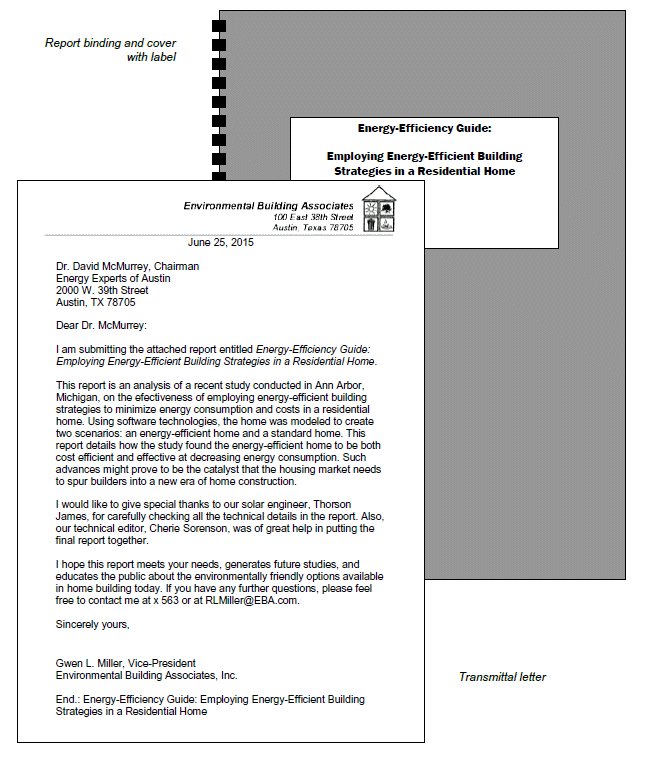
Letter of the alphabet or Memo of Transmittal
A letter or memo of transmittal announces the study topic to the recipient(s).
If applicative, the start paragraph should identify who authorized the report and why the report is significant. Provide the purpose of the report in the first paragraph as well. The adjacent paragraph should briefly identify, categorize, and depict the master and secondary inquiry of the report. Employ the concluding paragraph to offering to discuss the written report; it is likewise customary to conclude by thanking the reader for their time and consideration.
A letter of transmittal should be formatted as a business alphabetic character. Some report writers adopt to send a memo of transmittal instead. When because your audience for the letter of the alphabet or memo of transmittal, make certain that you lot employ a level of formality appropriate for your human relationship with the reader. While all letters should contain professional person and respectful language, yous should pay closer attending to the formality of the give-and-take selection and tone in a letter to someone you lot do not know. Effigy 11.two illustrates a report with a letter of the alphabet of transmittal.
Tabular array of Contents
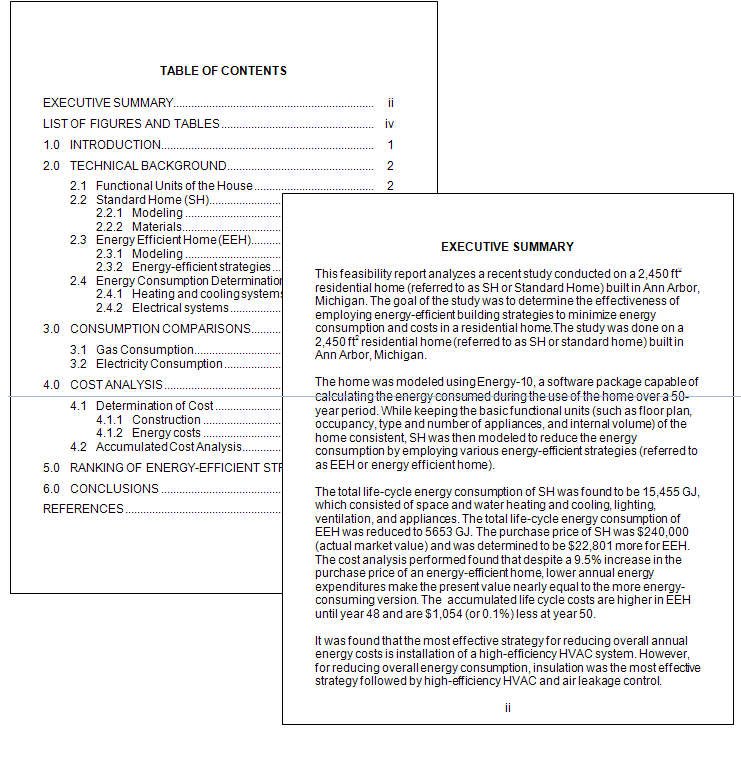
The table of contents page features the headings and secondary headings of the report and their page numbers, enabling audience members to quickly locate specific parts of the written report. Leaders (i.e. spaced or unspaced dots) are used to guide the reader's centre from the headings to their page numbers.
The words "Table OF CONTENTS" should appear at the tiptop of the page in all uppercase and bolded letters. Blazon the titles of major report parts in all upper-case letter letters also, double spacing betwixt them. Secondary headings should be indented and single-spaced, using a combination of upper and lowercase letters. Figure eleven.3 demonstrates the organization of a typical table of contents and executive summary for a report.
List of Figures and Tables
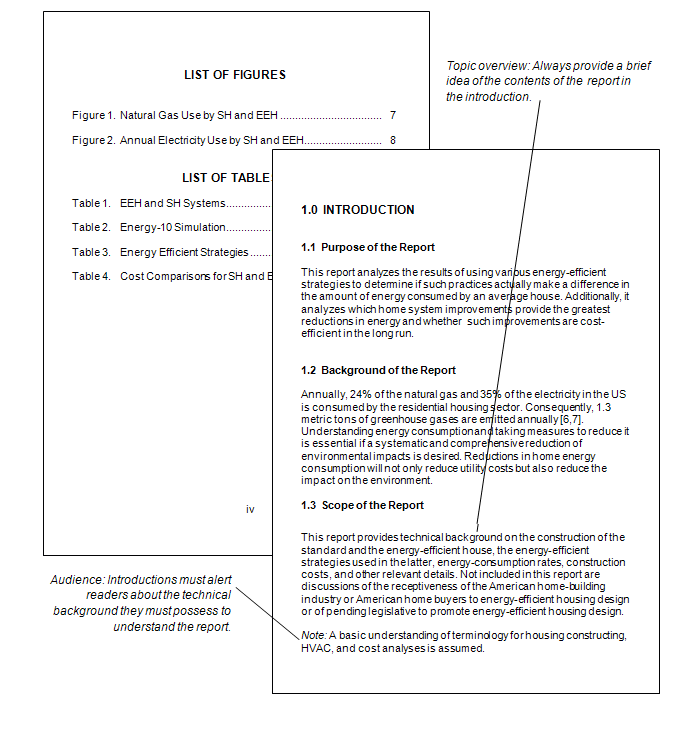
The listing of figures has many of the aforementioned blueprint considerations as the tabular array of contents. Readers use the listing of figures to find the illustrations, diagrams, tables, and charts in your report. Complications arise when y'all have both tables and figures. Strictly speaking, figures are illustrations, drawings, photographs, graphs, and charts. Tables are rows and columns of words and numbers; they are non considered figures. For longer reports that contain dozens of figures and tables each, create separate lists of figures and tables. Put them together on the same folio if they fit. Y'all tin combine the ii lists under the heading, "List of Figures and Tables," and identify the items as figure or table as is washed in Figure xiii.3.
Executive Summary
An executive summary presents an overview of the report that can exist used as a time-saving device past recipients who do not have time to read the entire report.
The executive summary should include a:
- Summary of purpose
- Overview of key findings
- Identification of conclusions
- Overview of recommendations
If the executive summary, introduction, and transmittal letter strike you as repetitive, call back that readers don't necessarily start at the beginning of a report and read page by page to the end. They skip around; they may scan the tabular array of contents and they unremarkably skim the executive summary for fundamental facts and conclusions. They may read carefully only a section or two from the body of the report, and then skip the residuum. For these reasons, reports are designed with some duplication then that readers will be sure to see the important information no affair where they dip into the written report.
To organize this section, type "EXECUTIVE SUMMARY" in all capital letter letters and centred. Follow this functional head with paragraphs that include the above information, but practise not employ commencement-level headings to split up each item. Each paragraph of information should be single-spaced with double spacing between paragraphs. Everything except for the title should be left-aligned.
An executive summary is normally ten percent of the length of the report. For instance, a x-folio report should offer a 1-folio summary. A 100-page report should characteristic a summary that is approximately ten pages.
Body
The trunk is the main section of the study and includes the introduction, discussion or findings, determination and recommendations.
Introduction
The body of a formal study begins with an introduction. The introduction sets the phase for the study, clarifies what need(s) motivated information technology, and orients the reader to its structure. Most report introductions address the following elements: groundwork data, problem or purpose, significance, scope, methods, system, and sources. As y'all may have noticed, some parts of a formal study fulfill similar purposes. Data from the letter of transmittal and the executive summary may be repeated in the introduction. Reword the data in society to avoid sounding repetitive.
To brainstorm this section, type "BACKGROUND" or "INTRODUCTION" in all uppercase messages. This functional head should exist followed past the data specified above (i.e., background data, trouble or purpose, etc.). Y'all exercise not need to utilize whatsoever first-level headings in this section.
Because this section includes background information, it would be the appropriate place to address the needs of audiences that may need additional knowledge about the topic. Provide definitions of technical terms and instructions virtually the overall projection if necessary. If yous are uncertain if your audience needs a particular piece of data, get ahead and include information technology; it's better to give your reader a piffling bit besides much background than non enough. The organisation of a typical introduction is illustrated in Effigy eleven.4.
Discussion of Findings
The Discussion of Findings section presents the evidence for your conclusions. This key section should be carefully organized to raise readability.
To brainstorm, type "Word OF FINDINGS" in all uppercase messages. Center this and all other functional heads. Follow "DISCUSSION OF FINDINGS" with a brief paragraph that previews the organization of the report.
Useful organizational patterns for report findings include but are not express to:
- Best Case/Worst Case
- Compare/Contrast
- Chronology
- Geography
- Importance
- Journalism Design
Employ a Best Case/Worst Case organizational pattern when yous think that the audience may lack interest in the topic. When examining a topic with clear alternatives to your proposed solution, consider using a Compare/Contrast pattern. Geographical patterns work effectively for topics that are discussed past location. When describing the organization of the written report in the start paragraph, broadly identify how the material in the report is organized rather than state that the report uses a specific pattern (e.g. Chronology, Geography). For example, write, "The research findings accost curriculum trends in three provinces: (a) British Columbia, (b) Alberta, and (c) Ontario," not, "This written report uses a geographical organizational pattern."
Follow the first paragraph with a starting time-level heading. Use outset-level headings for all other major parts of this section. First-level headings should appear in bold, uppercase letters. Center beginning-level headings, but marshal any 2d-level headings with the left margin. Type any second-level headings in assuming, upper- and lowercase letters.
As you present, translate, and analyze evidence, consider using both text and graphics. Accept into account what volition be easiest for your audience to understand. Include citations for all quoted or paraphrased material from sources likewise; bank check with your organization every bit to whether they prefer parenthetical citations or footnotes.
Conclusions and Recommendations
The conclusions and recommendations section conveys the key results from the assay in the discussion of findings department. Upwards to this signal, readers take reviewed the information in the written report; they are now logically prepared to read the written report's conclusions and recommendations. Type "CONCLUSIONS AND RECOMMENDATIONS" in all uppercase letters. Follow this functional head with the conclusions of the written report. The conclusions should respond whatsoever research questions that were posed before in the report. Nowadays the conclusions in an enumerated or bulleted list to enhance readability. Recommendations offer a course of action, and they should answer any problem or research questions also. Recollect back to the expectations of your audience. Have all of their requirements been addressed?
Back Matters
Back matters contain all the supplementary materials and can include works cited, appendices, a glossary and an index.
Works Cited
All formal reports should include a works cited page; this page documents the sources cited within the report. Documenting your information sources is all about establishing, maintaining, and protecting your credibility in the profession. You must cite ("document") borrowed information regardless of the shape or grade in which you present information technology. Whether y'all directly quote, paraphrase, or summarize information technology—it's still borrowed information. Whether it comes from a book, commodity, a diagram, a table, a web page, a product brochure, an expert whom you interview in person—information technology's nevertheless borrowed data. Utilise the documentation style advisable to your industry (e.g. APA, MLA, Chicago).
Appendices
Appendices are those extra sections post-obit the determination. What do you lot put in an appendix?—anything that does non comfortably fit in the chief office of the study simply cannot be left out of the report birthday. The appendix is commonly used for large tables of data, big chunks of sample code, fold-out maps, background that is likewise bones or too avant-garde for the body of the report, or large illustrations that just do not fit in the trunk of the report. Annihilation that you lot feel is likewise large for the main function of the report or that you call back would be distracting and interrupt the flow of the report is a good candidate for an appendix. Discover that each i is given a letter of the alphabet (A, B, C, and so on).
Note that this report organizational structure is a guideline and may differ from the standard used by your organization. If y'all are asked to write a study, detect out if there is a standard used in your organization. If not, the structure outlined to a higher place will suffice.
Headings
Headings are the titles and subtitles you lot run into within the actual text of much professional scientific, technical, and business writing. Headings are like the parts of an outline that have been pasted into the actual pages of the document. Headings are an important feature of professional writing. They warning readers to upcoming topics and subtopics, help readers discover their way around in long reports and skip what they are not interested in, and intermission up long stretches of straight text.
Headings are also useful for writers. They keep yous organized and focused on the topic. When you brainstorm using headings, your impulse may be to include the headings later you've written the rough draft. Instead, visualize the headingsbeforeyou start the rough draft, and plug them in as yous write.
General Guidelines
- Use headings to marker off the boundaries of the major sections and subsections of a report.
- Brand the phrasing of headings parallel.
- Avoid "stacked" headings—any 2 consecutive headings without intervening text.
- When possible, omit articles from the beginning of headings. For example, "The Pressurized Water Reactor" can easily be changed to "Pressurized Water Reactor" or, improve still, "Pressurized Water Reactors."
- Don't use headings as lead-ins to lists or as figure titles.
- Avoid "widowed" headings; that's where a heading occurs at the bottom of a folio and the text it introduces starts at the top of the next page. Continue at least ii lines of body text with the heading, or force it to start the new page.
Format and Style
The fashion and format for headings shown in this chapter is not the "right" or the "only" one; it is but 1 among many. As illustrated in Effigy 11.v headings part similar outline elements inserted into the text at those points where they apply.
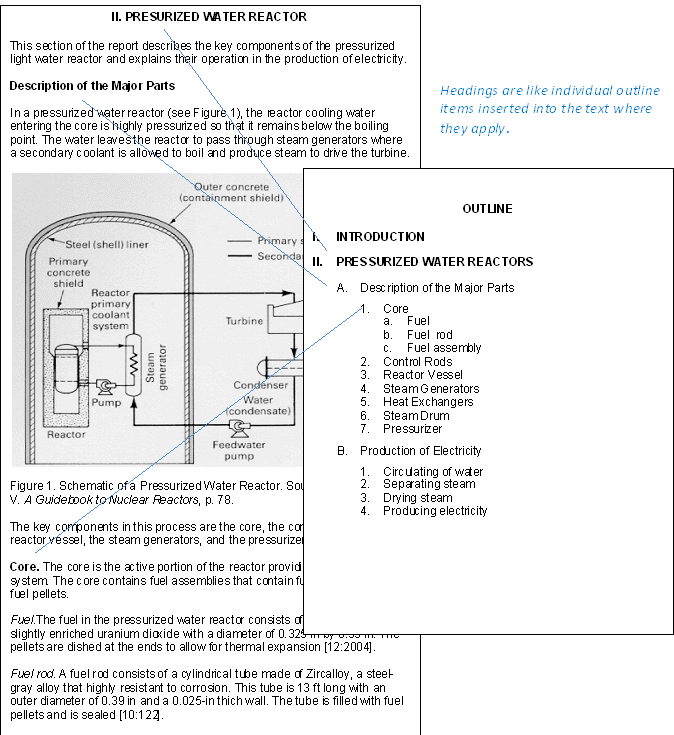
When formatting your headings and subheadings, pay close attention to details such as vertical and horizontal spacing; capitalization; use of bold, italics, or underlining; and punctuation. Headings occur within the trunk of a document. Don't confuse headings with document titles. Although titles may look like starting time-level headings in smaller documents, retrieve of them as separate things.
Showtime-level headings are the highest level of headings in your document. Apply the same format or style to all commencement-level headings. This mode should be unlike from that which is practical to 2nd-level heading. All 2d-level headings should have the same style. Similarly, this way should be different from that which is applied to third-level headings (and all third-level headings should take the same style), and so on. In that location are unlike ways and styles you can use to differentiate diverse levels of headings. Employ whatever styles are appropriate for the document and audience.
Lists
Lists are useful considering they emphasize selected data in regular text. Lists can be horizontal, with the listed items included directly in the sentence/paragraph. Lists tin can be vertical, such every bit when you see a listing of iii or 4 items strung out vertically on the page rather than in normal paragraph format. Lists, especially vertical lists, are noticeable and readers are likely to pay more attention to them. Certain types of lists also make for easier reading. For case, in instructions, information technology is a big help for each step to be numbered and separated from the preceding and following steps. Lists as well create more than white space and spread out the text so that pages don't seem like solid walls of words.
Similar headings, the diverse types of lists are an of import feature of professional person writing. They help readers understand, recall, and review fundamental points. They assistance readers follow a sequence of actions or events. They also break up long stretches of direct text.
General Guidelines
Follow these general guidelines when making lists:
- Employ lists to highlight or emphasize text or to enumerate sequential items.
- Utilise a lead-in to introduce the list items and to indicate the meaning or purpose of the list.
- Brand sure that each item in the list reads grammatically with the lead-in.
- Make list items parallel in phrasing.
- Avoid overusing lists because using likewise many lists destroys their effectiveness.
Bullet points are democratic, meaning each item in a bulleted list is of equal importance. This is in contrast to numbered lists where items may have dissimilar levels of importance, priority, or sequence. Employ bulleted lists for items that are in no required order. Employ numbered lists for items that are in a required order (such as stride-by-step instructions) or for items that must be referred to by item number.
Emphasis
Emphasis, every bit the term is used here, is the use of typographical furnishings to call attention to text. These furnishings can include italics, bold, all-caps, quotation marks, colour, and so on. Emphasis attracts the attention of the reader—or "cues" them—to actions they must take or to information they must consider carefully. Practically whatsoever special textual effect that is different from regular body text tin function as an emphasis technique. Things like italics, bold, underscores, caps, different size type, alternate fonts, color, and more than tin can act as accent techniques.
However, if emphasis techniques are used in excess, readers can get reluctant to read a text and may avoid it birthday because information technology is too busy or distracting. NOTICE how UNREADABLE this sentence IS BECAUSE As well MUCH emphasis is used .
Analyzing The Audience
As with whatever type of writing, when writing formal business reports, it is necessary to know your audience. For example, if your audition is familiar with the background data related to your projection, you don't want to bombard them with details; instead, y'all will want to inform your audition nearly the aspects of your topic that they're unfamiliar with or have limited knowledge of. In contrast, if your audience does not already know anything about your project, you will want to give them all of the necessary information for them to sympathize. Historic period and educational level are besides important to consider when you write. In addition, you don't want to use technical jargon when writing to an audition of non-specialists. These are but a couple of examples of dissimilar audience needs you will want to consider as you write your study.
Educational Level and Subject field Knowledge
While historic period may not necessarily be an event in the business concern world—your audience volition almost all be adults—educational level and cognition of your bailiwick are important to consider when writing your study. If you are writing for someone outside of your specific field, you will either need to exclude technical jargon or provide in-text reminders or indications of what specific terms mean or items are. For example, if you work for an automotive company, and you are writing on behalf of mechanical engineers merely for an audience of business professionals, y'all don't desire to assume that your audition knows the names of all of the parts that make up an engine; you will have to use terms they volition recognize. In some cases, a glossary of terms may be appropriate.
Expectations and Research
What does your audition wait to get out of reading your report? What is its purpose? Brand sure that you take specifically responded to the expectations of your dominate, manager, or client. If your audience expects you to accept research, make certain you know what type of enquiry they expect. Do they want research from scholarly journal articles? Practice they want you to conduct your own research? No matter what type of inquiry you do, make sure that it is properly documented using whatever format the audience prefers (MLA, APA, and Chicago Manual of Fashion are some of the most commonly-used formats). Yous also desire to plant a strong ethos in your report. Employ confident linguistic communication that shows that you lot have washed your inquiry and present them with the research.
For further information about what types of research you may want to include, see this article about research methods and methodologies.
Hither are some questions to consider virtually your audience as you lot write:
- What does your audience expect to acquire from your report?
- What type of ethos should you constitute?
- How much enquiry does your audience wait you to have?
- How current does your inquiry need to be?
- What types of sources does your audience expect you to have?
- What is the age of your audition?
- What is the educational level of your audience?
- How much groundwork information does your audition need?
- What technical terms will your audience need divers? What terms volition they already exist familiar with?
- What is the cultural background of your audition?
Integrating Graphics
Sometimes, despite writing clearly and concisely, it can be helpful to your audition if you use supporting graphics–whether that be tables, illustrations, maps, photos, charts, or another type of other visual aid.
Before getting into details on creating, formatting, and incorporating graphics, consider the types and their functions. You can use graphics to correspond the following elements in your writing:
- Objects: If you lot're describing a fuel-injection system, you'll probably need a drawing or diagram of the object. If yous are explaining how to graft a fruit tree, you'll need some illustrations of how that task is done. Photographs, drawings, diagrams, and schematics are the types of graphics that show objects.
- Numbers: If you're discussing the ascension cost of housing in Vancouver, you could apply a table with the columns being for 5-year periods since 1970; the rows could exist for dissimilar types of housing. You lot could testify the same information in the form of bar charts, pie charts, or line graphs. Tables, bar charts, pie charts, and line graphs are some of the main ways to show numerical information.
- Concepts: If y'all desire to evidence how your company is organized, such as the relationships of the different departments and officials, you could set up an organization chart, which is boxes and circles continued with lines showing how everything is hierarchically arranged and related. This would exist an example of a graphic for a concept; this blazon depicts nonphysical, conceptual things and their relationships.
- Words: Graphics can be used to describe words. You've probably noticed how some textbooks may put primal definitions in a box, maybe with unlike colours in the groundwork. The aforementioned can exist done with fundamental points or extended examples.
Documenting Graphics
Only equally you would cite and reference a paraphrase or a directly quote, so too must y'all cite and reference any graphics that you employ that were created past someone else or that were based on someone else'due south data. Indicate the source of any graphic or data you have borrowed. Whenever you infringe a graphic or information from some other source, certificate that fact in the figure title using an in-text citation. Y'all should also include the reference data in the reference list.
Guidelines for Using Graphics
- Apply graphicswhenever they would usually exist necessary.
- Make sure your graphics are appropriate to your audience, subject thing, and purpose. Don't include avant-garde, highly technical graphics your audience may not understand.
- Intersperse graphics and text on the aforementioned page. Place graphics as nigh to the betoken in the text where they are relevant as is reasonable and don't put them on pages by themselves or attach them to the terminate of documents. However, if a graphic does not fit properly on one page, put it at the peak of the adjacent, and continue with regular text on the preceding page. Don't leave one-half a page blank but to go along a graphic near the text with which it is associated.
- Always discuss graphics in nearby text preceding the graphic. Don't but include a graphic without an explanation. Orient readers to the graphic and explain its basic meaning. They need to have a purpose and be introduced before the reader encounters them on the folio. The showtime mention of a graphic is called a lead-in statement, and your graphics must always be introduced by a atomic number 82-in. Similarly, it is typically recommended to as well use a lead-out statement after the graphic. This is a statement that connects the figure to the fabric that follows.
- Use titles and labels for graphics.
- Include identifying detail such every bit illustration labels, axis labels, keys, and then on.
- Brand sure graphics fit within normal margins—if they don't, enlarge or reduce the copies. Go out at least 2 blank lines above and below graphics.
Computers have made it easier for professionals to create effective graphics. Most of the graphics in Effigy 11.6 tin can be created in Microsoft Office Discussion and Excel. At that place may as well be some occasions in which a formal written report includes graphics from a item print or online source. In these instances, it is critical to include a caption that presents the source of the graphic.
Figure 11.6 summarizes uses and audience benefits for the most ofttimes employed types of graphics.
Drawings, Diagrams, and Photos
To depict objects, identify, people, and relationships betwixt them, you can employ photos, drawings, diagrams, and schematics. Just every bit you would cite and reference a paraphrase or a direct quote, so besides must you cite and reference any illustrations, diagrams, and photos that you use that were created by someone else or that were based on someone else's information. Indicate the source of any graphic or data you lot take borrowed. Whenever you borrow a graphic or data from some other source, document that fact in the effigy title using an in-text commendation. You should also include the reference information in the reference list.
| GRAPHIC | Utilise | BENEFITS |
| Bar Chart | Represents data with the top or length of rectangular confined | • Compare items • Grasp a serial of numbers |
| Flowchart | Illustrates a sequence of events with shapes connected by arrows | • Grasp a series of steps |
| Line Chart | Shows changes in quantitative data over time or plots the relationship between ii variables with one or more lines | • Compare variables • Visualize alter over time |
| Map | Illustrates activities or trends on a map that represents geographically organized parts of a region, land, or the world | • Compare geographical trends • Grasp geographical relationships |
| Pie Chart | Depicts distribution of parts in a whole with wedges in a circle graph | • Compare significance of parts and parts-to-whole relationship(southward) |
| Table | Presents information or values in rows and columns | • Compare information or values • Grasp relationships between data or values |





Figure 11.six | Types of Graphics
Tables, Charts, and Graphs
Tables
Tables are rows and columns of numbers and words (though by and large numbers). They allow rapid access to and relatively like shooting fish in a barrel comparing of information. If the data is arranged chronologically (for example, sales figures over a ten-year menstruum), the table can show trends—patterns of ascension or falling activity. Nonetheless, tables are not necessarily the most bright or dramatic means of showing such trends or relationships between data—for that, you'd want to use a line graph, which is discussed in the next section.
Guidelines for using tables
Follow these full general guidelines when making tables:
- Every bit with other types of graphics, yous should refer to the table in the text just preceding the table.
- You should also explain the general significance of the data in the tabular array; don't expect readers to figure it out entirely for themselves.
- Don't overwhelm readers with big tables! Simplify the table information downwards to just that corporeality of data that illustrates your betoken—without of course distorting that data.
- Just every bit you would cite and reference a paraphrase or a directly quote, and then too must you cite and reference any tables that you lot apply that were created past someone else or that were based on someone else'south data. Indicate the source of any graphic or information you have borrowed. Whenever you borrow a graphic or data from another source, document that fact in the figure title using an in-text commendation. Yous should also include the reference information in the reference list.
Charts and Graphs
Charts and graphs are just another style of presenting the same information that is presented in tables. At the same time, even so, you go less detail or less precision in a nautical chart or graph than you do in the table. Imagine the difference between a table of sales figures for a ten-year catamenia and a line graph for that same information. You become a meliorate sense of the overall trend in the graph simply not the precise dollar amount. Other types of charts and graphs are horizontal bar charts, vertical bar charts, and pie charts.
Just as you would cite and reference a paraphrase or a straight quote, so likewise must yous cite and reference whatsoever charts or graphs that you employ that were created by someone else or that were based on someone else's data. Indicate the source of any graphic or data yous have borrowed. Whenever you borrow a graphic or data from some other source, certificate that fact in the effigy championship using an in-text citation. Y'all should also include the reference information in the reference list.
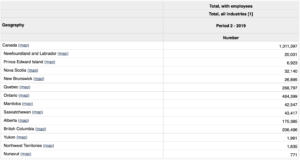
Source: Statistics Canada (2019)
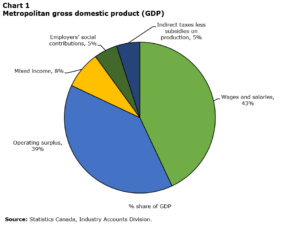
Source: Statistics Canada, Manufacture Accounts Division (2018)
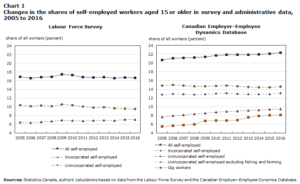
Source: Statistics Canada, Labour Force Survey and the Canadian Employer-Employee Dynamics Database (2019)
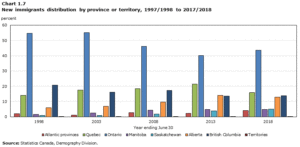
Source: Statistics Canada, Census Division (2018)
Checklist for Writing Reports
As yous reread and revise your report, go on in mind the following:
- Study considers the audience'southward needs
- Course follows function of report
- Format reflects institutional norms and expectations
- Data is accurate, consummate, and documented
- Information is easy to read
- Terms are clearly defined
- Figures, tables, and fine art support written content
- Figures, tables, and art are articulate and correctly labelled
- Figures, tables, and fine art are easily understood without text back up
- Words are easy to read (font, arrangement, organization)
- Results are articulate and concise
- Recommendations are reasonable and well-supported
Summary
Reports require system and a clear purpose. Business concern reports can be informational, analytical, formal and breezy. Though reports vary by size, format, and part, most include vi central elements. Equally with whatever type of business writing, it is important to apply audience assay to determine the system and content of reports.
End of Chapter Activities
11a. Thinking About the Content
What are your key takeaways from this chapter? What is something you accept learned or something you would like to add from your experience?
11b. Word Questions
- Accept you ever written a formal report?
- Do yous experience confident converting data into tables, charts and graphs?
- Find an annual report for a business yous would like to learn more about. Review it with the previous reading in mind and provide examples. Share and compare with classmates.
11c. Applying affiliate concepts to a situation
Quick Meals is a food commitment service that delivers a diverseness of repast options to customers at an affordable cost. They provide customers with a new carte du jour each week that they can utilize to choose items from for lunch or dinner. This service is used regularly by schools and businesses that practice non have a cafeteria but would like to provide students and staff with convenient meal choices.
Farshad works as an Operations Manager at Quick Meals. He notices that their services are in high need and decides to change the menus to offer healthier and more organic options. As a outcome, the meals cost more. Their regular customers are not pleased with this, and there is an increase in complaints and a decrease in sales.
Upon noticing the changes, Farshad calls a meeting with the supervisor of the customer service department, Susan. He asks her to reach out to the customers to discover out their thoughts on the card changes. Farshad intends to utilise this information to adapt the menus once more. Yet, this time, it will be to arrange the needs of the customers.
How should Susan go about getting this data to determine the issue?
11d. Writing Action
Watch this video from TED.com on Txtng is killing language. JK!!!. Nosotros tin can think nigh texting equally the contrary of what we would practice in a formal report. Summarize the video. Practise you think formal reports volition change in the future as the way we communicate changes?
Content Attribution
This chapter contains information from Business Communication for Success which is adapted from a work produced and distributed under a Artistic Commons license (CC BY-NC-SA) in 2010 past a publisher who has requested that they and the original author not receive attribution. This adjusted edition is produced by the University of Minnesota Libraries Publishing through the eLearning Support Initiative,Concern Advice For Everyone(c) 2019 by Arley Cruthers and is licensed under a Creative Commons-Attribution-NonCommercial-ShareAlike 4.0 International license, and Online Technical Writing by David McMurrey and is licensed under aCreative Commons Attribution 4.0 International License.
Media Attribution
Geography Icon fabricated past Freepik from www.flaticon.com
Flowchart Icon made by Becris from www.flaticon.com
Table Icon made by Nhor Phai from www.flaticon.com
Line Chart Icon made by DinosoftLabs from www.flaticon.com
Pie Chart Icon made by Freepik from world wide web.flaticon.com
Bar Chart Icon made past smalllikeart from www.flaticon.com
References
Government of Canada, S. (2017, September 29). Measuring the economy, region by region. Retrieved June 30, 2020, from https://www.statcan.gc.ca/eng/blog/cs/economy
Regime of Canada, Due south. (2018, September 27). Annual Demographic Estimates: Canada, Provinces and Territories, 2018 (Full Population simply) Analysis: Total Population. Retrieved June 30, 2020, from https://www150.statcan.gc.ca/n1/pub/91-215-x/2018001/sec1-eng.htm
Government of Canada. (2020, June 30). Canadian Business Counts, with employees, December 2019. Retrieved June thirty, 2020, from https://www150.statcan.gc.ca/t1/tbl1/en/tv.activeness?pid=3310022201
Guffey, Grand. E., & Almonte, R. (2019).Essentials of Business organisation Communication. Toronto, Ontario: Nelson.
Jeon, Southward., Liu, H., & Ostrovsky, Y. (2019, December 16). Measuring the Gig Economic system in Canada Using Administrative Data. Retrieved June thirty, 2020, from https://www150.statcan.gc.ca/n1/pub/11f0019m/11f0019m2019025-eng.htm
Source: https://pressbooks.bccampus.ca/businesswritingessentials/chapter/ch-11-writing-reports/
0 Response to "What effective structural cue does this activity report use to help the reader?"
ارسال یک نظر